
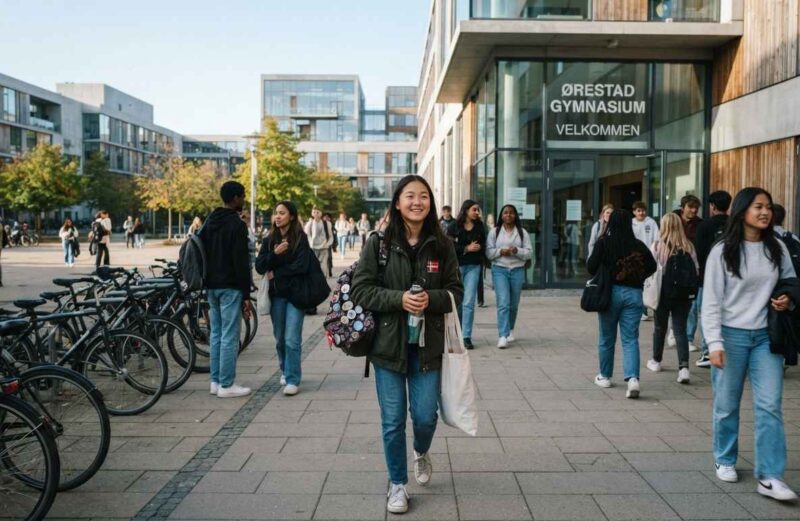
Studying abroad during high school can give students from Poland something that a short language trip cannot: daily participation in another education system, sustained language practice and the experience of building a routine in a different culture. Canada, the United States, the United Kingdom and Ireland offer distinct models, so choosing well means comparing far more than the destination itself.
What does a high school program abroad actually involve?
A high school stay abroad usually places the student inside a local or international secondary-school environment for a defined period. Depending on the destination and program, that may mean a term, semester or full academic year. The important distinction is that school becomes part of everyday life abroad, rather than being an occasional component of a language course.
Students therefore need to think about academics, accommodation and cultural adjustment together. A destination that looks attractive for travel may not necessarily offer the right subjects, school structure or living arrangement. The best match depends on the individual student, including age, independence, language level, interests and future academic plans.
High school programs available to students from Poland
For Polish families, the most common English-speaking options differ substantially in flexibility and structure. Some programs emphasize cultural exchange, while others allow students to select a particular school, region or academic pathway. Understanding the program model first makes country comparisons much more useful.
It is also worth separating the name of the destination from the type of program. Two students going to the same country can have very different experiences depending on whether they attend a public school, private school or boarding school and whether they stay with a host family or live on campus.
Canadian High School Program (Program szkoły średniej w Kanadzie)
Canada appeals to students who want a conventional high school experience with considerable regional choice. International students can attend schools in different provinces and districts, while accommodation may involve a host family or, in selected schools, a boarding environment.
Program length can also vary. A student may be interested in a shorter period, a semester or an entire academic year. Polish families researching a full-year option will often encounter the phrase rok szkolny w kanadzie when comparing how Canadian schools, accommodation and longer-term placements work. The district and school should be assessed together, because location can affect subject choice, activities and daily lifestyle.
Canada can be particularly interesting for students who want to combine academics with extracurricular activities. However, families should verify subjects, accommodation arrangements and recognition of school documentation before committing to a particular location.
USA J-1 Exchange Program (Program wymiany J-1 w USA)
The J-1 route is built around cultural exchange and immersion in American school life. Students normally attend a local high school and live with a host family, experiencing the school calendar, extracurricular activities and community life much as a local teenager would.
The trade-off is that a classic exchange model generally provides less control over the exact school or location than a more individually selected placement. For a student whose priority is experiencing everyday American culture rather than targeting one particular school, that can be part of the program’s appeal.
USA F-1 High School Program (Program szkoły średniej F-1 w USA)
The F-1 model offers a different proposition. It is generally suited to families who place greater importance on selecting a particular educational environment, such as a school, district or private institution that matches specific academic or extracurricular goals.
That additional choice makes it useful for students with more defined priorities. Someone interested in a particular sport, academic subject or preparation for further education in the United States may prefer a model in which the school itself plays a larger role in the initial decision.
UK High School and Boarding School Program (Program szkoły średniej i szkoły z internatem w Wielkiej Brytanii)
The United Kingdom offers a strongly academic route with several established qualifications. Depending on age and school, students may encounter pathways connected with GCSEs, A-Levels, the International Baccalaureate or other school-specific curricula.
Boarding schools add another dimension because accommodation, classes and extracurricular life take place within the same community. This can create a highly structured environment, but families should consider whether the student is comfortable with the independence and routines associated with residential education.
Irish High School Program (Program szkoły średniej w Irlandii)
Ireland can suit students looking for English-language immersion within a European setting. High school placements may combine attendance at an Irish secondary school with host-family accommodation, making everyday conversations outside the classroom an important part of the experience.
Its relative proximity to Poland can also matter to families who prefer a destination closer to home. Academic structure, available subjects and length of stay still need to be checked individually, since the right placement depends more on the school and student than on the country name alone.
Canada, USA, UK or Ireland: how the options differ
There is no universal ranking that identifies one destination as best. Each model solves a different problem: Canada can offer regional and school choices, the USA provides both classic exchange and more selective models, the UK has strong boarding and qualification pathways, while Ireland combines English immersion with a European location.
A useful comparison therefore starts with the student’s priorities. Someone focused on cultural immersion may evaluate programs differently from a student who needs specific subjects or has a long-term university plan.
| Program | Polish translation | Typical strength | Worth checking carefully |
|---|---|---|---|
| Canadian High School Program | Program szkoły średniej w Kanadzie | Choice of regions and different school environments | District, subjects, accommodation and duration |
| USA J-1 Exchange Program | Program wymiany J-1 w USA | Cultural immersion and local high school experience | Placement flexibility and eligibility |
| USA F-1 High School Program | Program szkoły średniej F-1 w USA | Greater ability to target a specific school | Tuition, school selection and academic fit |
| UK High School and Boarding School Program | Program szkoły średniej i szkoły z internatem w Wielkiej Brytanii | Structured academics and boarding options | Qualification pathway and residential life |
| Irish High School Program | Program szkoły średniej w Irlandii | English immersion within Europe | School curriculum, host family and length of stay |
The table is a starting point rather than a substitute for individual research. Specific schools can differ considerably within the same country, so students should compare actual placements after deciding which general program model suits them.
Five factors to compare before choosing a program
Destination is usually the most visible decision, but it should not be the first one. The practical structure of the stay has greater impact on everyday life: what the student studies, where they live, how much independence they have and what support is available when a problem occurs.
Families can make the comparison more objective by writing down their non-negotiable requirements before looking at individual schools. That makes it easier to distinguish between an attractive destination and a genuinely suitable educational placement.
- Academic compatibility: check available subjects, school level, timetable and how the period abroad fits the student’s education in Poland.
- Program duration: decide whether a short stay, semester or full year makes sense academically and personally.
- Accommodation: compare host-family life, boarding arrangements and the student’s readiness for each model.
- Location: consider climate, transport, community size and access to the activities the student values.
- Support: understand who assists the student locally and what happens if academic, accommodation or personal difficulties arise.
It is useful to rank these criteria rather than treat them equally. A student with a specific academic objective, for example, may need to prioritize subject availability over location, while a first-time traveller may place greater weight on support and accommodation.
Cultural adaptation is part of the education
The first weeks abroad often involve learning unwritten rules: how classmates communicate, how teachers expect students to participate and how social groups form. Adaptation happens beyond language proficiency. Students may speak English well and still need time to understand humour, routines and expectations in another community.
Schools that encourage inclusive communities can make that transition easier because belonging is shaped by small everyday interactions as much as formal policies. Students can contribute too by joining clubs, asking questions and avoiding the temptation to spend all their free time only with other international students.
Studying abroad also exposes teenagers to people whose family histories, languages and traditions may be very different from their own. Reading about cultural diversity across the world provides useful context, but living alongside that diversity makes it tangible. Shared classes, sports and ordinary conversations can challenge assumptions much more effectively than simply visiting another country as a tourist.
Questions students and parents should ask before applying
A good information session should produce concrete answers rather than broad promises. Families should know what they are actually choosing before an application moves forward, especially when the stay covers several months and affects the student’s regular education.
Questions should cover the school experience as well as the practical side of living abroad. It is better to resolve uncertainties about documents, accommodation and academic expectations early than to discover them after placement.
- Which schools or districts can the student realistically attend?
- Can the student choose subjects, sports or extracurricular activities?
- What language level is expected before departure?
- How is the host family or boarding accommodation selected?
- Who provides local support if a problem occurs?
- What documents will the student receive at the end of the program?
- How should those documents be handled after returning to Poland?
- Which expenses are included and which remain separate?
Answers should also be assessed against the student’s personality. A program can be academically suitable yet personally demanding if the student is uncomfortable with the level of independence, the accommodation model or the distance from home.
How to narrow the choice without becoming overwhelmed
A practical approach is to reduce the decision to three stages. First choose the type of experience: cultural exchange, targeted school placement or boarding education. Then shortlist two or three destinations. Only after that should the family compare individual schools and locations. This order prevents superficial comparisons based mainly on city names or photographs.
Students should also participate actively in the process. Parents naturally focus on safety, logistics and academic continuity, while teenagers may pay more attention to subjects, friendships, sports and daily life. Both perspectives matter because the student will live the routine every day.
Canada, the USA, the UK and Ireland can all provide meaningful high school experiences for students leaving Poland, but they do so through different structures. A sensible choice comes from matching the program with the student’s academic needs, maturity and expectations rather than simply selecting the most famous destination.
The strongest preparation combines realistic research with flexibility. Studying abroad is both an academic decision and a social transition, and students who understand both sides are better prepared to make their time overseas worthwhile.